10,000 to 26,000 Pounds
That is the practical medium-duty towing range in this guide, while the formal Class 4, 5, and 6 bands begin at 14,001 pounds and end at 26,000 pounds.
Tucson Towing Co. uses medium-duty towing for vehicles with a Gross Vehicle Weight Rating from 10,000 to 26,000 pounds, including many box trucks, delivery vans, ambulances, and small buses. That rating determines whether dispatch sends a dual-rear-wheel wrecker or medium-duty flatbed, so checking the VIN or driver-door GVWR sticker helps match the vehicle to the correct equipment.
That is the practical medium-duty towing range in this guide, while the formal Class 4, 5, and 6 bands begin at 14,001 pounds and end at 26,000 pounds.
GVWR is the manufacturer's maximum rated loaded weight, including cargo, passengers, and fuel. Read it from the driver-door label instead of relying on curb weight or a trim badge.
Dispatch should account for cargo at the time of the breakdown, single or dual rear wheels, hydraulic or air brakes, drivetrain, and roadway grade before choosing a flatbed or wheel-lift unit.
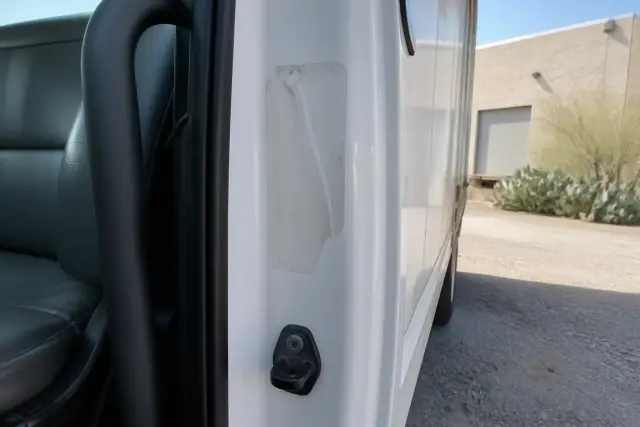
The manufacturer's GVWR label inside the open driver door. This is the rating a dispatcher needs to distinguish the loaded-weight class from curb weight.
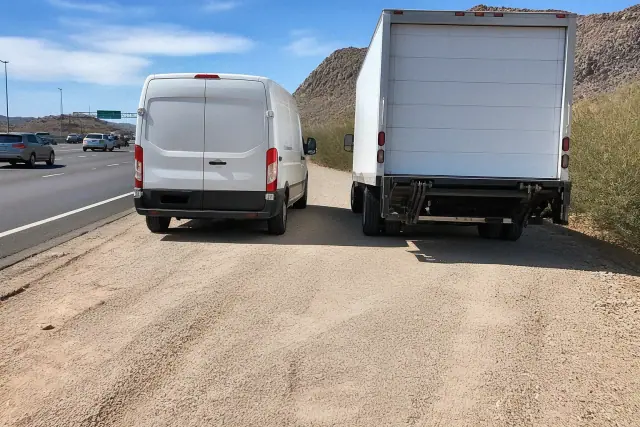
Both rear-axle configurations side by side. Wheel arrangement and brake type help explain why two vehicles near the same threshold may require different recovery gear.
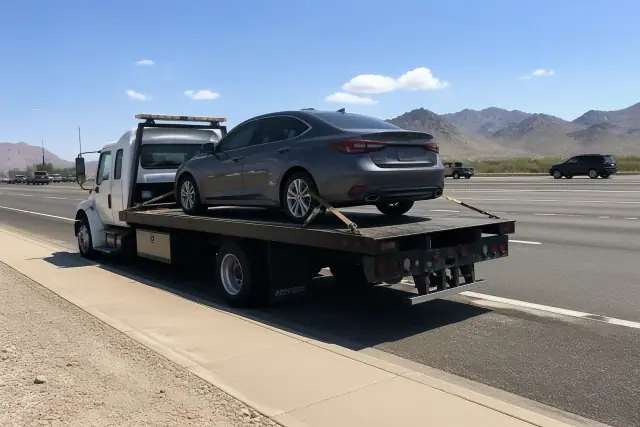
A load-rated flatbed keeping all drivetrain components off the ground. The scene should make axle limits, securement, and vehicle dimensions visibly relevant to the equipment choice.
A one-ton pickup can still be Class 3 and light duty despite an "HD" badge. The door-jamb rating is the deciding reference.
Cargo, passengers, fuel, axle setup, brakes, grade, and available loading space can change which medium-duty truck is appropriate.
Class 7 and 8 vehicles at 26,001 pounds GVWR and above move into heavy-duty towing and may need a heavy wrecker or rotator instead of a medium-duty unit.
Do not estimate vehicle class from appearance alone. Have the VIN or door-jamb GVWR ready so dispatch does not arrive with equipment that lacks the required capacity or attachments.
| Vehicle Band | GVWR | Typical Examples | Towing Implication |
|---|---|---|---|
| Light duty | Up to roughly 8,500 to 10,000 lb | Sedans, pickups, and small SUVs | Normally handled by light-duty equipment. |
| Lower medium-service range | 10,000 to 14,000 lb | Some commercial cutaway and loaded passenger vans | Some towers use medium-duty equipment before federal Class 4 begins. |
| Class 4 | 14,001 to 16,000 lb | Large vans, lighter box trucks, and some motorhomes | Confirm brakes, rear axle setup, cargo, and access. |
| Class 5 | 16,001 to 19,500 lb | Box trucks and midrange commercial vehicles | Dedicated medium-duty recovery gear is generally appropriate. |
| Class 6 | 19,501 to 26,000 lb | Larger box trucks and small buses | Verify wheel-lift or flatbed capacity against the loaded vehicle. |
| Heavy duty | 26,001 lb and up | Class 7 and 8 semis, large motorhomes, and municipal buses | May require a heavy wrecker or rotator with 50-ton-plus winching. |
GVWR is the maximum loaded weight the manufacturer allows, not the vehicle's empty curb weight. Cutaway delivery vans commonly carry a 10,000- to 14,500-pound GVWR; extended vans built for 12 to 15 passengers can reach 12,500 to 14,000 pounds once loaded; and Class C motorhomes commonly fall between 12,000 and 16,000 pounds. Most 20- to 26-foot box trucks are rated between 14,500 and 26,000 pounds. Motorcycles are typically under 1,000 pounds and need wheel chocks and soft-tie straps rather than medium-duty recovery gear.
Truck selection also depends on single versus dual rear wheels, hydraulic versus air brakes, cargo at the time of breakdown, drivetrain, and roadway grade. Gates Pass and the climb toward Mount Lemmon add stress to brakes and drivetrains, while summer pavement temperatures above 140 degrees can soften asphalt and complicate recovery angles. The medium-duty units described for this service carry air-brake glad-hand connections, dual-wheel-lift attachments, DOT-compliant lighting, and load-rated chains and straps. Their wheel lifts handle up to roughly 17,000 pounds, their winches rate around 25,000 pounds, and their flatbed decks can carry loaded box trucks within Class 6 axle limits. Flatbed transport also keeps all-wheel-drive and dual-rear-wheel drivetrains off the ground when a wheel lift could cause damage.
Is a one-ton pickup medium duty? No: it is generally Class 3 and remains light duty regardless of an "HD" trim label; true Class 4 begins at 14,001 pounds GVWR. Does pulling a 12,000-pound trailer require a CDL? Not automatically, but a trailer rated at 10,001 pounds or more makes the vehicle-and-trailer combination especially important, and a Class A or B CDL typically applies once combined GVWR crosses 26,001 pounds, depending on configuration and use. Check the specific ratings and Arizona Motor Vehicle Division guidance before towing that load regularly.
Share the vehicle type, location, cargo status, breakdown condition, and GVWR from the VIN or driver-door sticker. Those details help Tucson-area dispatch decide whether the job needs a medium-duty flatbed, wheel lift, accident recovery, or roadside assistance before a truck is sent.